|
The earliest traces of settlement in Ashur can be found in layer H of the Ishtar temple, but also in the oldest layers beneath the Old Palace, dating to the late Early Dynastic period (in the middle of the 3rd millennium B.C.). In the following Akkadian period (ca. 2340–2200 B.C.) which is represented by layer G of the Ishtar temple, Ashur is under the rule of the kings of Akkad. During the time of the 3rd Dynasty of Ur (ca. 2100–2000 B.C.) a governor of this dynasty is attested in Ashur. After the end of the 3rd Dynasty of Ur independant local rulers take over the rule in Ashur. The city deploys to a centre of long distance trade along with a network of commercial settlements or trading colonies in Anatolia (so called karum period). In Ashur the temple of Ashur and Adad is built and the city gets protected by defensive walls. In the end of the 19th century B.C. Ashur becomes the centre of a developing Assyrian territorial state under the rule of Šamši-Adad I. (1808–1776 B.C.), a contemporary of Hammurapi of Babylon. During this time the Old Palace, the Ashur-Enlil ziqqurrate and a new temple for Ashur, which will keep its layout until the end of the Assyrian empire, were built. After Šamši-Adad’s death his empire decays and Ashur loses its importance. During the 16th century the city’s diffensive constructions become extended. One of the rulers responsible for this is Puzur-Aššur III. (in the middle of the 2nd millennium) who encloses the southern residential area, the New City, and connects it to the old centre of the city. Later Ashur becomes part of the empire of Mitanni which spreads over huge parts of northern Mesopotamia and Syria. Under the reign of Eriba-Adad I. (1382–1356 B.C.) and his son Aššur-uballit I. (1355–1320 B.C.) Assyria is able manages to gain indipendence from the Mitanni dominion. In the 13th century B.C. Ashur once more is one of the most dominant political powers in the Near East. Adad-nirari I. (1295–1265 B.C.), Salmanassar I. (1264–1234 v. Chr.) and Tukulti-Ninurta I. (1233–1197 B.C.) are responsible for Ashur’s reconstruction and restoration of its temples and palaces. In the end of the 12th century B.C., at the time of Assur-reš-išis (1133–1116 B.C.) and Tiglatpilesar I. (1115–1075 B.C.), the Anu-Adad temple is built. In the 9th century B.C. under Assurnasirpal II. (883–859 B.C.) Assyria’s political centre is placed to Nimrud and later, under Sargon II. (721–705 B.C.) to the new city foundation of Dur-Šarrukin. Sargon’s son and heir to the throne Sanherib (705–682 B.C.) choses Ninive as new centre for Assyria. Notwithstanding the shift of seat of the gouvernment, Ashur stays residence of the national god Ashur and the religious centre of the Neo-Assyrian state. Various building activities of the Neo-Assyrian kings, amongst those activities the foundation of the festival building (bit akitu) by Sanherib show the continuing importance of the former capital as religious centre. Until the end of the Neo-Assyrian period, Assyria’s rulers are buried there. In the year 614 B.C. Ashur becomes occupied and destroyed by the army of the Median king Kyaxares. In the 1st century B.C. Ashur is resettled and becomes a Parthian administrative centre. At this time an agora with public buildings develops in the northern part of the city. In the southern part a palace is built and on top of the Assyrian Ashur temple they build a sanctuary for the deity Assor. Under the Sasanian ruler Shapur I. (241–272 B.C.) the city becomes destroyed once more. During the Islamic period the city is still inhabited. Between the 12th and 13th century A.D. a bigger settlement is attested for this place which belongs to the state of the Zangids of Mosul and later to the Ilhan empire. Later in time Bedouins pitch their tents in the ruins from time to time. One part of the former settlement area is used as graveyard until the 70ies of the 20th century A.D.
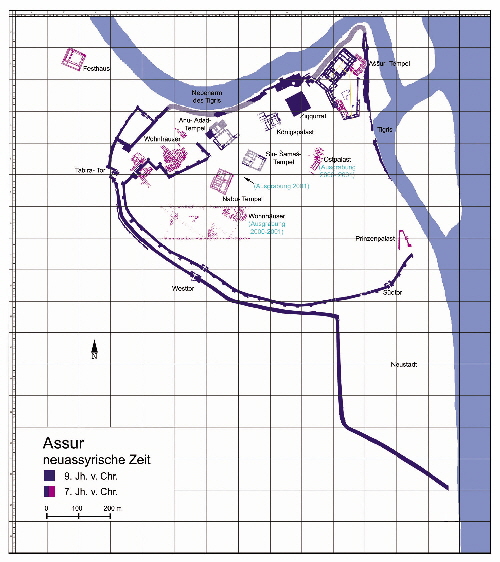 Ashur from 9th to 7th cent. BC 
|